
Parful Events
Run an invitational where the field is exactly who you invited
An invitational is defined by its field. The organizer decides who is asked, how many players each invitee may bring and how big the field can be, then has to keep the tee sheet true to that list as people accept, decline and swap partners. Parful Events puts the control in the registration itself.
For the club committee whose invitational is forty member-guest pairs, the regional body running an amateur open with three handicap flights, and the business owner whose field is sixty hand-picked customers with no public link. Invitees register with an email address and no Parful account; scorers and spectators never sign in.
The invite list is the field
Set the event page to password protected and it is unreadable without the code. Set registration to invite-only and load the list: a name, an email, a company if it matters, and the number of player spots that invitee may claim. A member invited with a guest gets two; a sponsor with a foursome gets four. Checkout checks the buyer against the list by invite link or email, and an address not on it cannot register however it got the link. Each invitee sees their own status, never the list.
Packages carry the price of a place: a pair for a member-guest, a single spot for an open, a foursome where teams enter together. Buyers pay by card as guests, or the organizer registers an invitee by hand and records a check. Each player claims their own spot from an emailed link, which is how the tee sheet gets real names and handicaps. A declined invitation is revoked and its spots return to the field; a claimed player who drops out has the spot revoked and reissued with a fresh link.
- The cap is the field size; a waitlist holds the people the committee would take if a pair withdraws. Transfers are checked against the list again
- Dated early-bird tiers, sponsor packages tracked to paid, and scheduled sends for the invitation, the reminder and the pairings
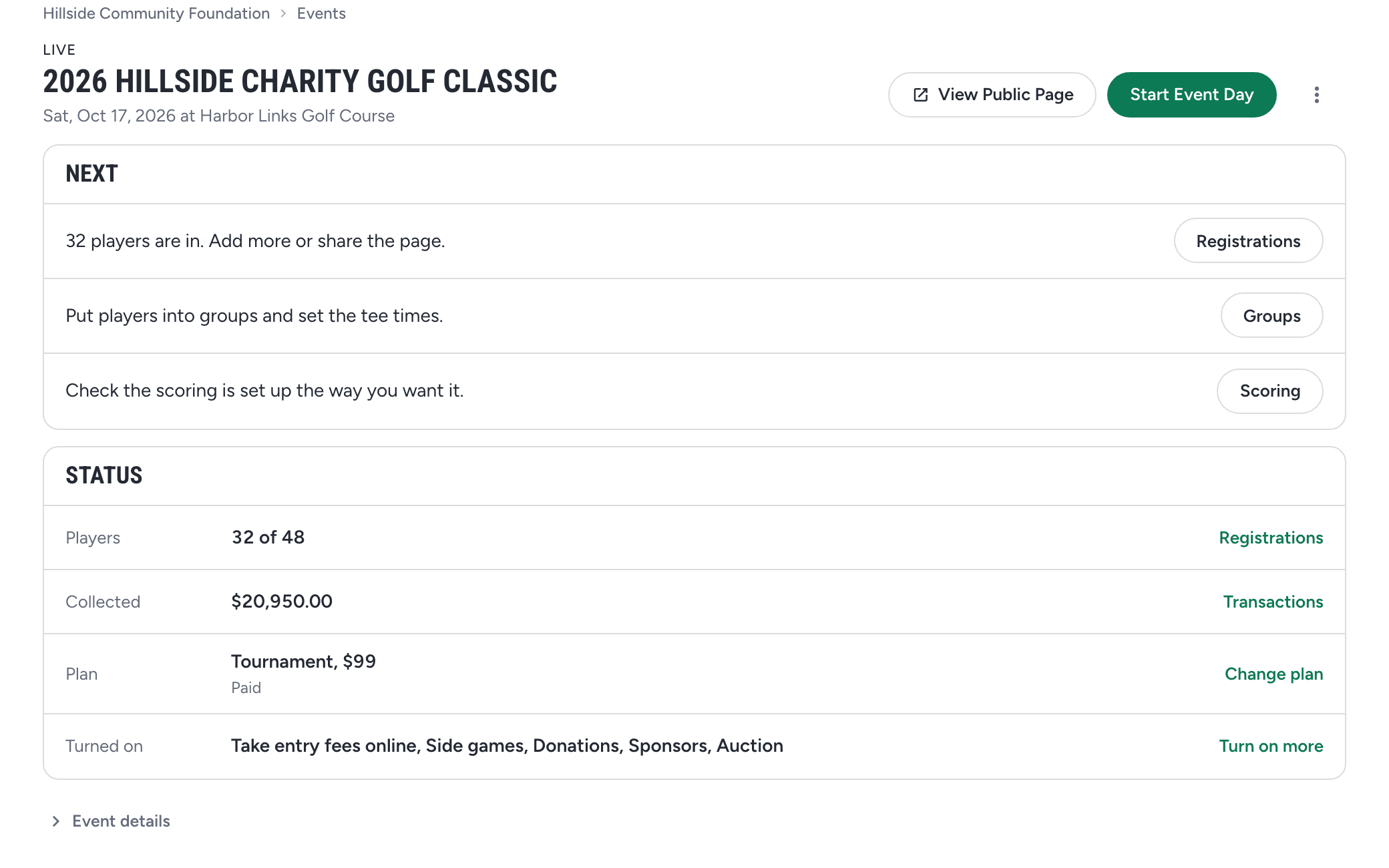
Flights, tee times and a proper tie-break
The check-in desk finds players by name or scans their confirmation, shows any balance owed and records what is paid there. Groups are built from the claimed spots, with tee times or a shotgun start. For a stroke-play field, flights are built before anyone tees off, by handicap or by hand, each on its own tee if the field spans a wide range, and frozen once the first group is out.
Scoring is one phone per group in the browser, in stroke play or Stableford for an open, best ball for a member-guest, or a scramble, with the allowance from the round rules, which freeze when scoring opens. The live leaderboard is a public link by flight and overall, and the clubhouse TV board rotates it with the sponsors. A tie is settled by countback or a sudden-death playoff recorded hole by hole; if the light goes, the organizer declares a winner with a reason or falls back to countback or a shared placing, and the leaderboard labels it.
- Tee sheet, scorecards, card labels, cart cards, run of show and volunteer roster print from the reports; a card desk takes paper scorecards
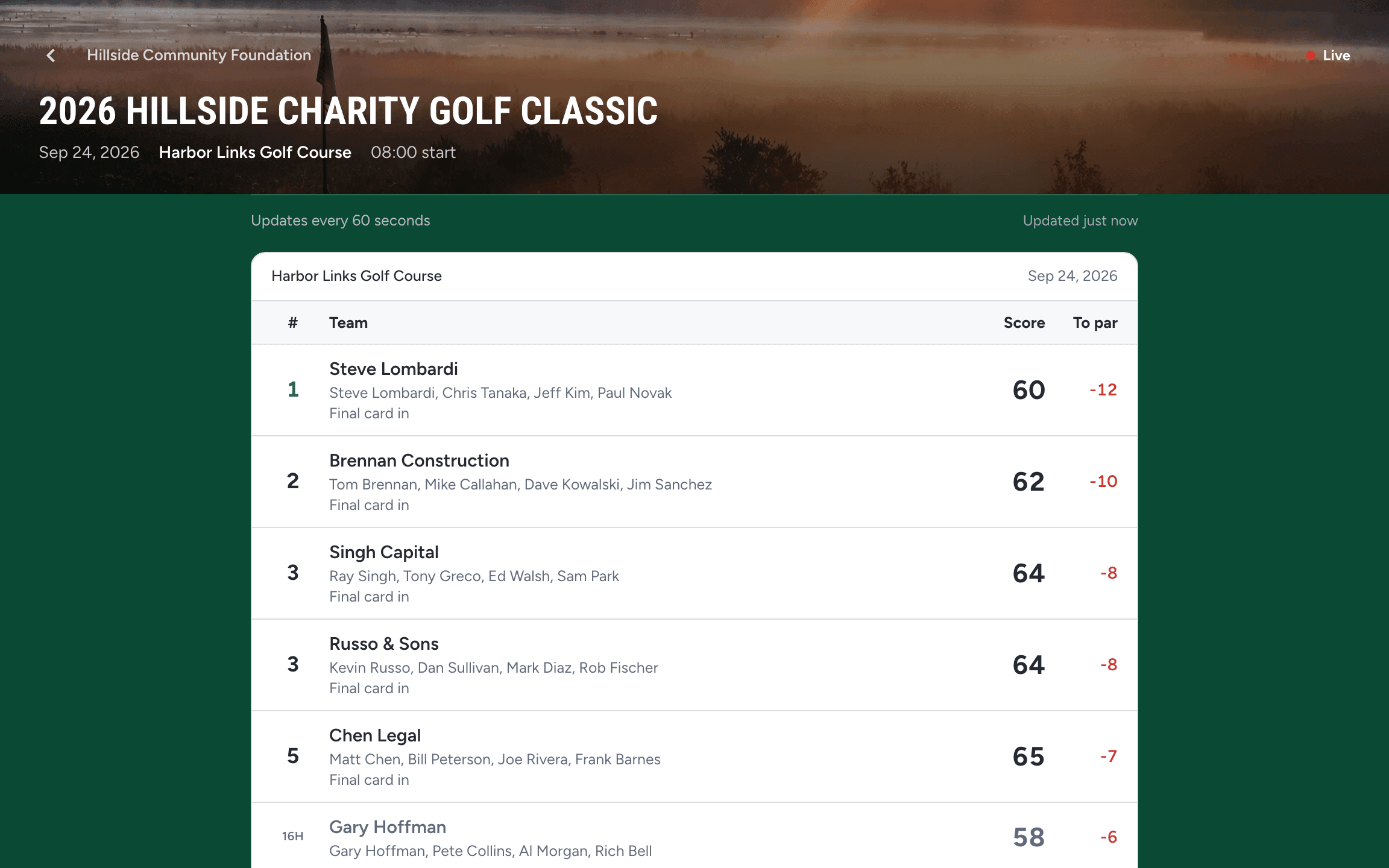
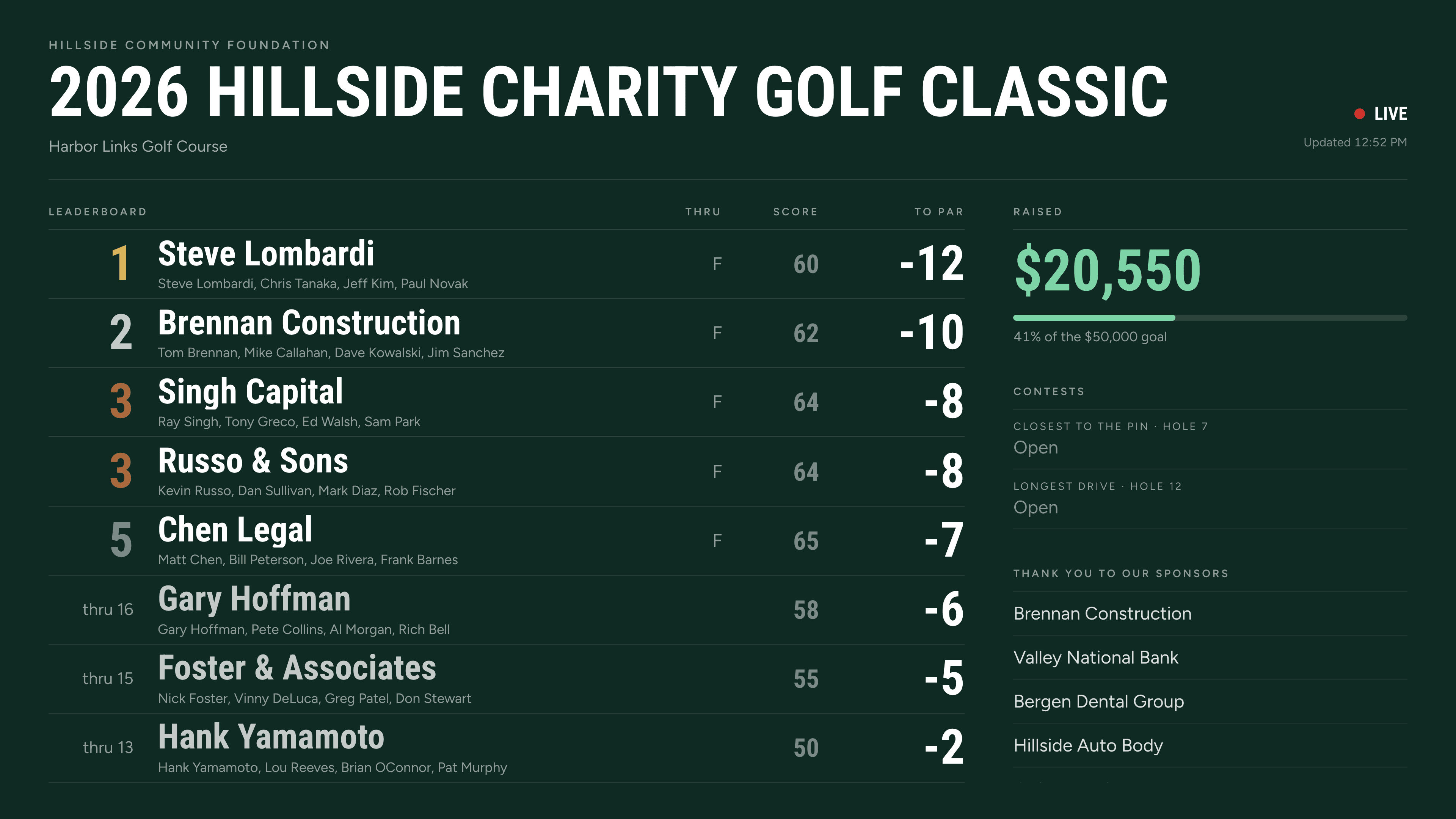
Results by flight, then the books
Results go to every registrant by email and the leaderboard stays live. The awards report lists gross, net, flight and contest winners, and a correction opens a recorded window so the published result has a trail.
The Money Desk closes the day: entry fees, sponsor deals and desk payments reconciled by method, the expense register against the budget, and the closeout report with revenue, expenses and the net. An invitee approved to play on a balance sits on the receivables list until it is settled; each sponsor gets a recap report and a printable invoice. Next year, duplicate the event: packages, sponsor levels, rounds and display settings carry over, registrations and money reset.
A member-guest: 40 pairs, best ball, three flights
Forty members each bringing one guest, best ball of the pair, three handicap flights, a capped field. Every step is one the product runs today.
- Eight weeks out
- Password on the page, registration invite-only, forty members loaded with two spots each, a pair package with an early-bird tier, a cap of 40 pairs with a waitlist. The invitation goes out with the password.
- Weeks 6 to 2
- Members buy the pair as guests and each player claims a spot and enters a handicap. Three members decline and are revoked, three pairs come off the waitlist, one guest is replaced by reissuing the spot.
- Week 1
- Build three flights by handicap, set the tees per flight, freeze them, build the groups with tee times, and print the tee sheet and cart cards.
- The day
- Check-in by scan, scoring opens with the round rules frozen at best ball, one phone per pair. The leaderboard runs by flight on the clubhouse TV, and a tie in the second flight is settled by a two-hole playoff recorded from the organizer’s phone.
- The week after
- Results by email, the money closed, the closeout report to the committee, and the event duplicated for next year with a fresh invite list.
Worth knowing before the invitations go out
- Invite enforcement is by email address; a forwarded link does not carry an invitee’s entitlement to someone else.
- A player claims a spot by confirming their email from the claim link, with no password or profile, or signs in if they already have an account.
- Flights apply to stroke-play and Stableford fields. Match play brackets are not part of this page; if the invitational is a knockout, ask before you promise it.
- You pay per event when you activate it, with no subscription; a multi-day event adds a per-day fee, never a per-player one. A one-day stroke play or scramble event runs free, with any number of players.
Invitational questions
What software can run an invitational golf tournament?
How do we stop the link being forwarded?
Can a member bring a guest without the guest being on our list?
What happens when someone drops out?
What does an invitational cost to run on Parful?
Load the invite list and let the field build itself
Set the password, give each invitee their spots and let the players claim their own places. Pay per event when you activate it; a one-day stroke play or scramble event runs free, with any number of players.
Events is being finished. Existing events keep working; creating new ones opens when it is ready.